



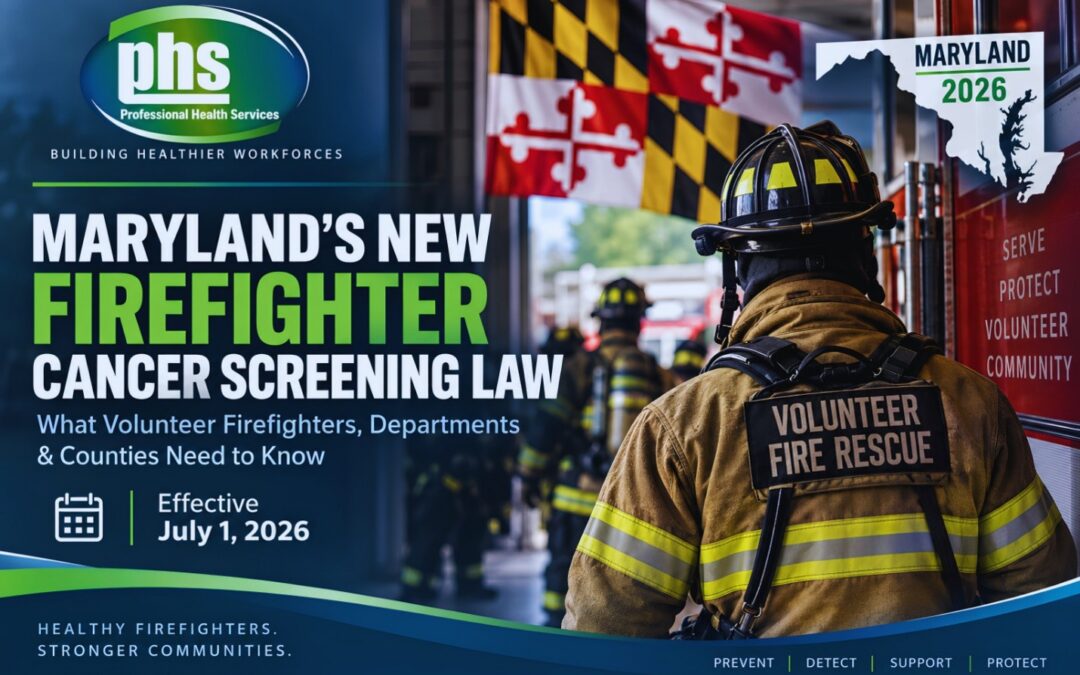
Maryland Firefighter Cancer Screening Law: What Volunteer Firefighters Need to Know
Maryland has established new cancer screening requirements for the volunteer fire service. Effective July 1, 2026, counties with volunteer fire companies must offer no-cost preventive cancer screenings to eligible active and retired volunteer firefighters.
Enacted as Chapter 319 of the 2026 Laws of Maryland, the law addresses more than screening access. It defines who qualifies, assigns responsibilities to counties and volunteer fire companies, establishes an annual reporting requirement, and ties preventive cancer screening to current firefighter-specific guidance.
What Does Maryland’s Firefighter Cancer Screening Law Require?
Each Maryland county with a volunteer fire company must offer eligible active and retired volunteer firefighters no-cost preventive cancer screening.
Chapter 319 does not establish a static list of mandatory tests. The law requires screening to follow the latest screening guidelines issued by the International Association of Fire Fighters (IAFF).
This structure allows screening protocols to keep pace as firefighter-specific recommendations change instead of relying on a list of tests fixed when the legislation was enacted.
When Did the Law Take Effect — and What Happens October 1?
The law took effect July 1, 2026.
October 1 has a separate purpose.
Each volunteer fire company must maintain an up-to-date list of its active volunteer firefighters and qualifying retired volunteer firefighters. That information must be provided to the county on or before October 1 each year and whenever requested by the county.
The county must maintain the information submitted by its volunteer fire companies.
For fire chiefs and department administrators, accurate membership records are therefore an immediate part of implementation. October 1 is the annual roster deadline; it is not the effective date of the law.
Who Is Covered?
Chapter 319 treats active and retired volunteer firefighters under separate eligibility criteria.
- Active volunteer firefighters: The statutory definition covers firefighters actively involved in fire suppression and volunteering with a volunteer fire company in a Maryland county. There is no three-year minimum service requirement for an active volunteer firefighter.
- Retired volunteer firefighters: A qualifying retired member must have volunteered with a county volunteer fire company, participated actively in fire suppression, completed at least three years of volunteer service, and met the applicable point requirement under a Length of Service Award Program (LOSAP) or qualifying alternative point system.
The three-year requirement applies to qualifying retired volunteers—not current active volunteers.
That distinction matters when departments prepare the annual rosters submitted to their counties.
Who Is Responsible for Providing the Screening?
The responsibility to offer the no-cost preventive cancer screening rests with the county.
Volunteer fire companies are responsible for maintaining and submitting the required membership information. Counties are responsible for offering screening to the eligible firefighters identified under the law.
In practice, counties will need to determine how screenings will be funded and delivered, how firefighters will be scheduled, and how providers will accommodate the operational realities of a volunteer fire service.
What Cancer Screenings Are Required?
Chapter 319 does not prescribe a permanent list of cancer screening tests. It mandates alignment with the latest IAFF screening guidelines.
The law allows a county to provide a no-cost annual examination that includes preventive cancer screening consistent with those guidelines.
For counties developing a firefighter cancer screening program, the clinical process deserves as much attention as the individual tests. Screening results require appropriate medical interpretation and clear communication.
When a finding requires further evaluation, firefighters also need a defined pathway for follow-up.
Those elements turn a collection of tests into a functioning occupational health program.
What Does the Law Say About MCED Testing?
Chapter 319 specifically addresses newer cancer detection technologies.
Counties may apply for funding through Maryland’s Professional and Volunteer Firefighter Innovative Cancer Screening Technologies Program. The law expressly identifies a multicancer early detection (MCED) blood test as an example of an innovative cancer screening technology eligible under this provision.
MCED testing is not mandated for every eligible firefighter.
The grant provision gives counties a potential funding pathway for incorporating advanced blood-based cancer screening technology into their programs. Decisions about its use should remain connected to appropriate clinical protocols and the other screening services provided to firefighters.
What Should Counties and Volunteer Fire Companies Be Doing Now?
Volunteer fire companies should review their membership records and confirm that they can accurately identify active firefighters involved in fire suppression and retired members who meet the law’s separate eligibility requirements.
Counties have a broader operational task. Program planning should address:
- Eligible firefighter population and annual roster management;
- Screening protocols consistent with current IAFF guidance;
- Locations and scheduling that accommodate volunteer firefighters;
- Medical oversight and physician interpretation;
- Confidential communication of individual results; and
- A defined process for abnormal findings and follow-up.
How screening is delivered can directly affect participation. Volunteer firefighters may be balancing full-time employment, family responsibilities and department obligations. Requiring multiple appointments at different locations can make participation difficult.
Coordinated on-site services can reduce those barriers while helping departments limit disruption to normal operations.
Building a Sustainable Firefighter Health Program
A successful firefighter cancer screening program needs a clear clinical pathway from screening to interpretation to communication and follow-up.
Professional Health Services (PHS) provides mobile occupational health programs designed around the operational needs of fire departments and public safety agencies. On-site delivery can consolidate services, reduce travel and scheduling demands, and provide departments with a coordinated approach to preventive health screening.
For Maryland counties implementing Chapter 319, the immediate priorities are clear: identify who qualifies, maintain accurate rosters, establish appropriate screening protocols, make participation practical, and ensure firefighters have a pathway for medical review and follow-up.
That is how a legislative requirement becomes a working firefighter health program.
Healthy Firefighters. Stronger Communities.
Professional Health Services
Building Healthier Workforces